00:00
00:00
‘’My work is in acoustic space. Now with a spatial awareness that seeks to envisage space not as one encompassing, homogenous space, but as a borderless area filled with complex, simultaneous and overlapping relations of different and shifting social and acoustic spaces. Creating sonic experiences with these considerations therefore involves dynamic interaction within and between these physical and social spaces. Realised through a same time navigation of technological space and so development of tools and interfaces to enable the enquiry, the individual listener and socio-cultural communities always central. I seek to listen.” KM March 2016
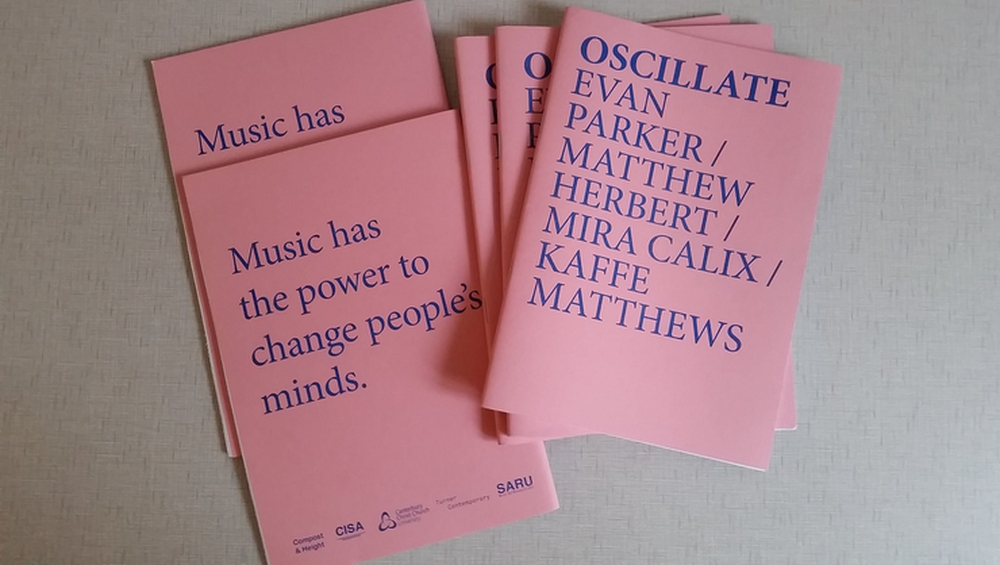
The multiple lives of bicycles. Chapter 5, Oscillate. Published by Compost and Height 2017, edited by Robert Stillman, in collaboration with Canterbury Christ Church University and Turner Contemporary.
2017
Sitting writing in my studio I have to get up to see what’s making the noise ambling right to left across the window. It’s the street sweeping lorry going about its early morning business. It’s just rained so its rubbery wheels on the smooth tarmac only renewed last month sound different to before. At the same time I’m hearing a Spanish woman sing cut up and close behind my head. She sounds sultry and dark. I’m remembering that I first heard her when I broadcast it on a hot summers Sunday afternoon in 2003 and I was running Radio Cycle 101.4FM, the public radio station direct from my studio. I’m now listening to the recording of Day One and I’m hearing myself ask my imagined listeners to contact us, to call or come in with ideas or material, to make programs at our free daily workshops in the local library or come direct to the studio and broadcast their stories, their music, recipes, things they need to say. The entire thing an improvised performance from start to end twenty four hours daily for seven continuous days.
It’s a strange thing to make live radio. Make sound in one space to send to invisible listeners in some other unknown space. Is there anybody out there?
Last week I made a concert in a vast London church. I talked to the audience before but couldn’t see anyone when I came to play. I could hear and feel and smell them listening. I knew some would be watching me playing, their presence creating the new sound and acoustic in the church since the sound check. I played therefore in the way that I did because of that. It’s subliminal and simple. It’s the essence of the act of music making. At the end they yelled their enthusiasm. They spoke and wrote to me afterwards wanting to share their trip.
This week that concert was broadcast on the radio. Some of them wrote to me again saying how different the piece sounded. It was good to hear they thought that too. Technically of course it had to be different. I had made the piece in four channels, the sounds and voices swooping and swirling up and down and around the audience and though it was a binaural recording, the result transformed the performance into another stereo radio experience devoid of humans at all. (The cheering was even cut out at the end). “You had to be there” they said.
Air. The vibrations of air molecules and so the existence of sound as waves.
It’s 2003. I’ve been making and performing new electro-acoustic music around the world since 1995 and have released six solo CD’s. I am dying to pause and work face to face with my local community. To hear what they want to make, have to say. To play them the unfamiliar noise I make, to work with the to and fro, new dialogue of people and spaces away from the exclusive immersion of the art music world.
Radio is exciting as radio waves are these tangible things that exist and can behave without this medium of air. They are electromagnetic and have their own physicality.
You can generate radio waves from a transmitter tuned to send out on a chosen frequency via an antenna. Set up a receiver tuned to that same frequency and you will receive this frequency along with any sound you send along it. Amplify your received signal, send that out through speakers and bingo, radio. You will hear whatever is being sent out from the location of your antenna. With our Radio Cycle community radio license allowance, we could broadcast over a 3 mile radius of London and with the antenna on the roof, direct from my studio.
Not only then did I have a direct way to communicate locally, but it would be a two way thing. Anyone could come and broadcast. We were setting up an invisible tangible network, not the internet, not remote and virtual worlds, or over in Australia or Mexico, but right here in Hackney, restricted to 3 miles. The back-and-forth between someone who’s providing or shaping sound and someone who is listening. Through performance, working with communities, through radio, could the music, the sounds made also act in a way to get us people to see, to recognise, to understand each other?
Note, I was also feeling that by grappling with radio waves and their substance, I was somehow working with and understanding sound in a new and different way.
Now let’s imagine the receiving radio antennae are not just located in unknown homes and cars, but on the street and moving. Playing the broadcast sounds through the shifting acoustics and atmospheres of empty suburban streets, the roads and pavements stuffed with cars and busy striding people. Not necessarily loud these sounds, this music, but just enough to tweak someones ear as they strolled about their day. Was that a trumpet gliding by?
It had dawned on me that radio could be used as a mobile stage. And that I wanted to work with people to make pieces for the local streets, for mobile riding pedestrian audiences, realised through broadcast, radios strapped to the front of bicycles, audience riders cycling specific routes. The score that route, a map, the compositional content inspired by, made from that route; maybe. The performance the journey. The sound shared outside to anyone passing.
And what of the cyclist? Hearing the broadcast, the gig, reshaped by their ride through the city, creating a new concert for each and every rider with the ebb and flow of the day’s sounds. How is that? And of course there’d be the moments when the signal would be blocked, cut off by tall buildings or damp foggy days, the sound sweeping in and out with fuzzy noise additions. And these moments would oft be the best we think as it feels like you are hearing the air, its physicality made tangible.
2006.
I have retreated inside and gone physical. This time with the score the map of the human body and making music that moves over and through it, to feel not just listen to. I have designed a Sonic Bed to do this which is proving to be an incredible instrument and portable performance space. It’s an oversized king size bed with six bass speakers under the mattress and eight mid speakers hidden in upholstery around the sides. It is sleek, minimal and luxurious in its design and modern simplicity. There are also steps to climb up to get inside and lie down and hear and feel the specialist music move up and down and around you. It is also an experiment in social space. Will you get into bed with a stranger?
Sonic Bed composition relates to a miniaturised but controlled version of radio cycling in its movement, although experience for audience must be completely different. I use a theremin and digital oscillators to bend different tones sinusoidal up and down and around audience’s lying bodies. Single traces sliding gliding, another pausing fat to vibrate under butt, calf, darting lattices sparkling overhead. Anyone of any age or culture who climbs into the Sonic Bed comes out smiling.
Now sitting in the Bed over six sub woofers, eight mid and tweeter pairs around me, laptop and OSC controller on my lap, I work tiny and precise for hours. After four months experimenting with an architect and a musician-coder in our studio Lab, there are too many ideas to work with. We had been discussing space and designing and using digital tools to make and shape and play different sounds within the Bed. We had struggled to find a language. I had struggled to find a language, especially with the architect. Sound deals with time. Space does not. I have been fascinated by space since the beginning. I want to articulate it. Articulate?
~ articulation is the act of speaking or expressing an idea in words ~
In that case, what does articulate space actually mean? To talk about space? To re-identify what is space? To express it through a series of sounds? By taking sound through it in order to transform it? To speak through it? Architectural music. I think this is what I make.
In early summer, we had invited locals of all kinds to come into the Lab and lie in our Sonic Bed results. We listened to what they said, noted down their feedback and added their ideas into the mix when we could. Now alone I am using this research and learning how to make specific and different shapes with sound. Inspired by our white coat Lab approach, I am working in a methodical, arduous kind of way. It’s a several stage process and I need more discipline. Ha. I am having to put aside ten years of improvising to be able to complete the thing I am attempting to make first. And with the Sonic Bed, there is the addition of feeling the sound which adds this other layer.
For example, a single sound increasing and decreasing in volume creates a growing mound sensation. Playing a sound next to it and the sound nearest the ear dominates. Playing the same sound in a plane opposite it and the sound leaves its mound sensation and moves in a line back and forth across the Bed. Add in the neighbouring sound and the effect is increased changing the single line shape into a geometric pattern. Specifically, if using high frequencies, this is the way to make a lattice effect over the body.
2008
I am needing to make music for outside spaces.
“ I am reconsidering time and building non linear works that hover invisible in the air until they are triggered to play by a passing visitor. I am doing this in two ways.
One; inside, Sonic Beds, full body listening and static.
Two; outside, Sonic Bikes, expansive ear listening and roaming.
Both instances create audio environments away from our self-controlled solo perambulating sound spaces, the roving headphones, the self-designed portable home space transfer systems. Both instances also take new music away from the confines of the concert hall or gallery, away from the start finish ritual of the performance, inadvertently turning the visitor into performer. Transforming the public sound space, sometimes so subtle, into patches of musical vitality. Was last night so good or was someone really singing at the traffic lights?
I want to re-work spatial considerations. Explore maps as musical scores and mapping as shifting structures moving in networked layers. Hook musical phrases, fragments of sound onto them and use invisible connection possibilities to start and stop and recombine the sounds afresh, depending on where you the listener goes on the street.
Roaming listening uses the street and maps, our routes as scores, the audience carrying the music through neighbourhoods on Sonic Bikes. Radio Cycle used FM transmission to do this, but now in Folkestone, South East coast of England, the combination of local hills, the power of French radio signal transmission across the Channel, government control of airwaves plus cost of licensing means we have to find another way. Fortunately, the portable tech is now available and we can access Global Positioning Systems. We connect.
MAR- fabulous, VELO – bicycle, MARVELO – cool.
A beautiful fat-walled Martello Tower overlooking the Folkestone streets below, a perfect sound laboratory. Throw a net. Catch the digits beamed down from space that mark our streets, our fields, our land and sea as numbers and map them. Work with brilliant young ears and minds of local residents to make music that tells of their thoughts and places. Attach these pieces in sonic fragments to the map of digits then travel with it.
You will be able to hear the work unfold locative. Unfurl, jump out, reveal itself in fragments and phrases and silence and noise and threads of melody as you go. Sounds collide at the corner and switch, no end, bang into another libretto as left you go instead. Hark how fresh and varied the sonic landscape becomes, how you tune into those details near and far.
Why pedal on two wheels? The bike carries the hardware leaving you to float around listening, dull suburban streets transformed to movies, and the downs truly make the ups more than worth it. “
So yes, I designed the Marvelo, aka Sonic Bike. It’s a development on the radio carrying bicycle in that it has two frame mounted speakers on the front with a GPS receiver and small computer carrying the sounds and music in fragments and phrases in a weatherproof box on the back. With its bespoke mapping software, different sounds are linked to different places meaning that the music played overall changes dependent on where the cyclist goes and how fast they ride. The pieces therefore are interactive and completely site related for the performer / audience rider and those that the bike passes.
The aim. To build a portable sound system that would perform a full range of frequencies which could clearly be heard from a moving bicycle on a possible windy seaside afternoon. Negotiating audio quality against accurate triggering and cross fades against hard drive power along with the requirement to reliably run the entire kit from a 12V battery for eight hours daily for three months daily is challenging. Acquiring the optimum system, including best but not large speakers, powering everything and securing it successfully to a bicycle that could still easily and safely be ridden is complex. Do not underestimate how important it is to get this right. You are dealing with other people. They need to be and feel safe.
“ Ooo no, you’ll never get stereo on a bike love, use one of these nice round speakers, yes…. mounted in the middle..”
“ Use headphones,”
“ Use computer speakers,”
“ Use those fabulous i-pod speakers,”
“ Use those fabulous waterproof i-pod speakers. ”
Has anyone who cares about music ever listened to these things? (Ed note. It’s 2008) A month of research proved that no computer speakers are worth it, they might be remedied with a bass box but it’s not possible to carry one, and the best way forward is with domestic hi-fi EVO bookshelf speakers, (also in many colours) a 350W Kenwood stereo car amp, (nowadays very hard to find something not too huge and powerful) powered by a 12V lead acid motorbike battery.
Outcome. Stereo from a bike not possible? Fie! Domestic streets with tall Georgian houses provide a stunning acoustic and a clear stereo image could be heard even through the noisy bus laden streets. We have never heard stereo on the move like this before, and that’s just for the rider. Testing all everywhere ceaselessly amuses and delights passers by. “Wicked! Is that a sound system she’s got on her bike ? !” We move on.
Not an app and free of the internet, the Sonic Bike creates an outdoor listening experience for everyone – reaching new audiences on the street or hillside, far beyond the confines of concert halls and galleries. The Sonic Bike can be many things – a musical instrument, a portable stage, a game player, a doorway to listening and looking that creates good health.
2013
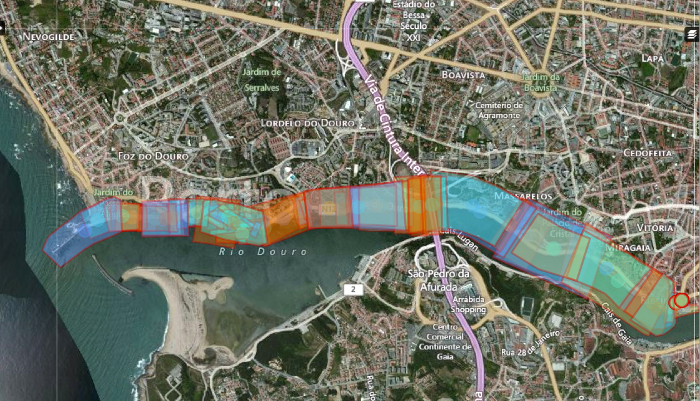
I have returned to London after three months in Porto researching the city and collaborating with theatre company Visões Úteis to make and direct the huge collaborative sonic bike work Opera fixi. It’s the first time I’ve made a bike piece that had to use a specific route, and I’ve had to do it here because Porto is hilly and cobbled and the only tenable place to ride heavy sonic bikes is along the river Douro to the sea and back. Thus this path has become the score and the river’s life within and contemporary human life growing and collapsing alongside the source for the libretto.
Portuguese word fixe means cool in English but ‘sounds’ fish in Portuguese.
Fixe ‘sounds’ fixy in English. fiXi?
With this linear structure to contend with, depart the city to the sea, turn around and return along same path, it was a surprisingly inspiring restriction. Leave home, struggle to ride against sea wind, reward arrival at ocean. Oh! Ah! Smell. Breathe. Rest. See. Turn round, be blown gently home, the nearing city in dipping light welcoming, sea wind pushing, music and story unfolding and driving and filling the ride as you go.
Opera fiXi’s content was inspired by contemporary fishing issues, the pollution in the river Douro causing male fish to turn female, the duration of an overnight fishing trip combined with the urge for gentrification along its river banks cheap and collapsing amidst the traditional homes. Opera fiXiI tells of a time and place where the fishermen are women and the mermaids are men. Where the mermen have breasts and seaweed hair and play fishing line harps, and the fishergirls wear fishskin suits as they sail out to sea singing songs pitched at the frequency of the human heart (298.5Hz), calling to the male fish to come into their huge meshed nets woven from their hair and grape vines.
This also needed local people and voices to work with and perform the songs which altogether involved a choir of fisherwomen from across the river, a group of children aka the Pollution choir, a rap crew, one of Portugal’s most notorious rock singers, a Bass opera singer, some theatre students, a digital water quality professional, an elderly man and woman who never met to play the lovers, and members of NEFUP – a group of ethnographic vocalists who also adapted fiXi lyrics to two of their folk songs’ extraordinary harmonies. All lyrics also had to be translated from my English to their Portuguese, Visões Úteis brilliance, and made still to scan. Then of course recorded, mixed and placed into the Sonic Bike map score. “Oh, but it didn’t sound right at the corner, place it under the bridge.” Back to the studio adjust adjust, on the bike, out again..
Alongside of course there is the essential digital technical development required. Collaborating coder Dave Griffiths, rarely on site but mostly available remotely calmly chats and sends tiny files with crucial numbers enabling the Sonic Bike to play one sound file when travelling in one direction and a different sound in the same place when travelling in the opposite direction. So riding along by the river gives you something going to the sea and something else on the way back. Deviate from the path too far and you get nothing, ride too fast and you might miss the geese flying over the bridge or the end of the lovers duet or the Captain’s solo at the statue or the narrator’s pollution data narrative. And then of course there are the shifting layers of electronic counterpart. Lattice? And of course, every sonic fragment is purposefully made and finely mixed and marked to exactly that spot with as much precision as GPS (+/- 5m) will allow.
And what inspired determined what was made? When did she ever write songs or lyrical melody?
Sonic cycling takes audiences on beguiling journeys, often beautiful and otherworldly, at times funny and maybe strange but always convincing. FREE.
Now summer time in London and Dave is in the same physical place as me. The fiXi work has not only created a solid team of 12 reliable and developed Sonic Bikes but the collaborative and site specific nature of the compositional process has been stunning.
“ We’ve got to make Sonic Bikes available to anyone Dave. Not just us. They’re real instruments now and imagine all the different kinds of musics o! that could be made in other hands.”
And so with an Open Lab week of interactive experiments in the local park we develop the Sonic Bikes to be sensitive to each other so that one could control or switch another’s sound, fitting simple accelerometers to bend a bikes playing tone by leaning or tilting the bike as you ride and , of course, covering a bike in contact mics and discovering its most interesting sounds dependent on speed and surface.
“Hey Kaffe, its like you’ve turned the bike into a microphone,” they say as I come rattling into the yard
“ Yeey“, I say, “it’s really surprising where the contact mics need to go, but hey…. this is more like a bicrophone isn’t it?! Hey! Ah ha! This is bicrophonics! We’re doing bicrophonics! “
Bicrophonics is a new practice, discovered through the application of portable digital technologies to the needs of composing for outdoor spaces by using bicycles. Arising from electroacoustic site specific composition and performance, as well as live, multichannel, installation and durational works both in and out of doors, bicrophonics allows another approach and specificity to working with composition in context. The compositions that are made move through space, not with a static audience, but with the audience that is also moving through that space and its always changing soundscape. This shifting duality creates a unique situation for every audience member and every resultant composition and has also revealed an extraordinary understanding in the essence and power of context in contemporary composition.
The Bicrophonic Research Institute (BRI) is the organisation that has grown to support and facilitate the ongoing development of bicrophonic practices worldwide, using open source software at every level, all designs being shared and published online. Making thirteen international projects over ten years, it continues to develop the Sonic Bike to do this. Though discovered with the bicycle, its system is also being developed within other strands such as sonic kayak and sonic walking projects.
Bicrophonics is about the mobility of sound, experienced and shared within a moving space, free of headphones and free of the internet.
Established by Kaffe Matthews and Dave Griffiths in 2014, the BRI works collectively from a London Lab, undertaking multiple projects annually, each one realising new site-specific music made through residential collaborations with producers and communities. Politics, time, cycling possibilities, architecture and finances all bear on each project, making them utterly contemporary. Alongside, the BRI runs local workshops in Sonic Bike making and open source development, all information of which is shared online. These projects are resulting in the growth of independent sonic cycling hubs worldwide – currently in London, Finland, Houston, Brussels and Berlin.
2015
Finding Song Home is a bicycle opera now running in the multi-cultural city of Brussels. You can go to La Monnaie de Munt opera house, pick up a Sonic Bike, check the map and go explore the sound tagged streets through the city, from the centre out to the Moroccan neighbourhood of Molenbeek and far along the canal. The bike is a traditional Belgian bike with speakers mounted at the front and a small computer with sounds and GPS receiver boxed on the back, and as you set off and ride into the plaza, gongs and dongs will sound and pitch change around you as you navigate the square amongst bemused shoppers and lovers stopped static, transfixed by this outdoor concert passing. And for you the plaza is transformed as you realise you’re hearing Moroccan men shouting, selling something.. vegetables? and bags are rustling and kids are chattering and the water fountain is panning noise to right and left as you turn in different directions so that the real shoppers dissolve and suddenly two girls are proposing ideas of life without money in your ear and an electronic pulse then oboe singing arrives to envelop and guide you on through the next street, everything so different.
This is the world of sonic biking, in which audience can cruise through landscapes on a bicycle mounted with speakers, the sound, music, noise, narratives that play, that they move through changing dependent on where they go and at what speed they travel. To date I’ve made ten of these pieces, understanding more each time about how to use the shifting context, audio landscape, passing street and its changing physical and social architectures, acoustics – oh for miserable empty suburban streets or downtown Houston at night reflections! – weather, time of day, people/animal absence/presence, social demagogue to determine, to enable the audio material used, made, positioned and played. The city and its streets determine the composition. Its sounds and content realised through the site specific collaboration.
Apart from receiving GPS data to enable the sonic bike to interact with its location so playing a specific sound file, there is no numerical data being read to create this music. However, the site, the moving street I realise is the algorithm. Providing an invisible source that cannot be quantified or written down, but utterly feeding and determining what and how things work and what therefore is made.
It’s a month ago and I’m sonic biking through central Brussels, hearing a guy from Guinea softly talking above the bullish traffic about how it was only when he left Africa, that he realised that the world is so big. That the world is too big for him. That he had had no idea it is like this here in Europe. And I’m riding amongst cars and buses, past varieties of shops and busy humans marching up and down, sirens kicking and tears come and I am understanding something of his experience. Later I’m recording Jimmy from the Congo not wanting to talk but instead play djimbé. He plays and sings with a passion and freedom I’ve not heard since Senegal in 1986. It’s amazing. Later in the studio I’m listening to it thinking but how do I use this material? This is 80’s world music, this is not my thing. But a few days later it’s on the bike and it hits as I ride into a soulless city street and it jumps life now and it’s the best thing. And totally contemporary.
I devised and am now evolving this practise of bicrophonics, these bicycle instruments, portable, individual concert halls, to make and realise new site specific audio experiences on every occasion. Pieces that sonically and physically engage, interact with and move through outside space. That can only exist in certain locations. Whose content is utterly determined by the context for which they are made. That immerse the rider/audience member into a new and living listening experience who inadvertently also becomes performer. That plays to a second audience randomly passing. Who themselves might receive a flash of something new into their day.
Finding Song Home was a huge collaborative project that grew over six months in Brussels. I wanted to make it to explore and raise questions on the injustices of birthright and the powers that enable or prevent the free movement of citizens across the world. It was made with the Bicrophonic Research Institute(BRI) and was commissioned by opera house La Monnaie de la Munt and Q-O2.
2017.
There are four new Sensory Bikes in Berlin. These are our latest development, transforming the Sonic Bike into a live instrument whose sounds can not only be played or triggered by where the rider goes, but actually made by how the rider rides. Bike mounted sensors manipulate the sound playing according to whether the rider cycles backwards or forwards for example, speed of pedal turn stretching voice into other sounds, the brakes stepping through different filters, in some zones, the rider able to “play” a synthesiser with handle bar movement and speed combined. The Sensory Bike therefore is a new bicycle instrument to be played by the rider audience -performer, creating the potential for new movement-generated sound works and performative cycling spectacles.
And this has been my interest since Porto. To make the Sonic Bike more of an instrument for riders to play and so make the music. For it to be more than a playback device for audience to ride and listen to. STOP. The Sensory bikes were weeks of work to build and with sensors are more delicate than than the Sonic Bike. They also really are instruments so need months of work to make music that is more than gestural. Obviously bike synthesiser playing can only safely happen in open spaces or parks, so our original bicrophonic system is still essential. Conclusion, work is now progressing for Sensory Bikes to be composed for and used as performance instruments for ensembles of players. For the bikes to become able to behave as a swarm or herd. That their presence or absence and distance form each other will affect what each other bike plays. No longer just independent solo beasts. And for audience to come gather and watch their shows.
My central motivation behind taking myself off the performance stage some ten years ago was to find ways of making new music more accessible to more people. To step away from the exclusivity of the club and gallery and concert hall, and to find different ways of doing this oft working direct with people and communities. Space and place were found to be shared ways in, though from different angles for all of us, and the collaborative political works we’ve made have been rewarding and surprising and inspiring. We explored and learned things we would not have done otherwise and we’ve touched many, if only for a moment.
Bicrophonics is proving to enable this growth. However, what I find thrilling now is the realisation that making new music live in front of an audience, for them to witness solo human struggle and see and hear unknown music unfold in front of them is once again vital. With all that is becoming mass produced, consumed, known, labelled, pre-determined, its seems more important than ever that our contribution is to work live and visible.
Bibliography/Links
1. https://wp.kaffematthews.net/works/radio-cycle-1014fm/
2. http://www.annetteworks.com
3. http://musicforbodies.net
4. http://sonicbikes.net
5. http://kaffematthews.net