00:00
00:00
24. October 2025 | Franziska Busse
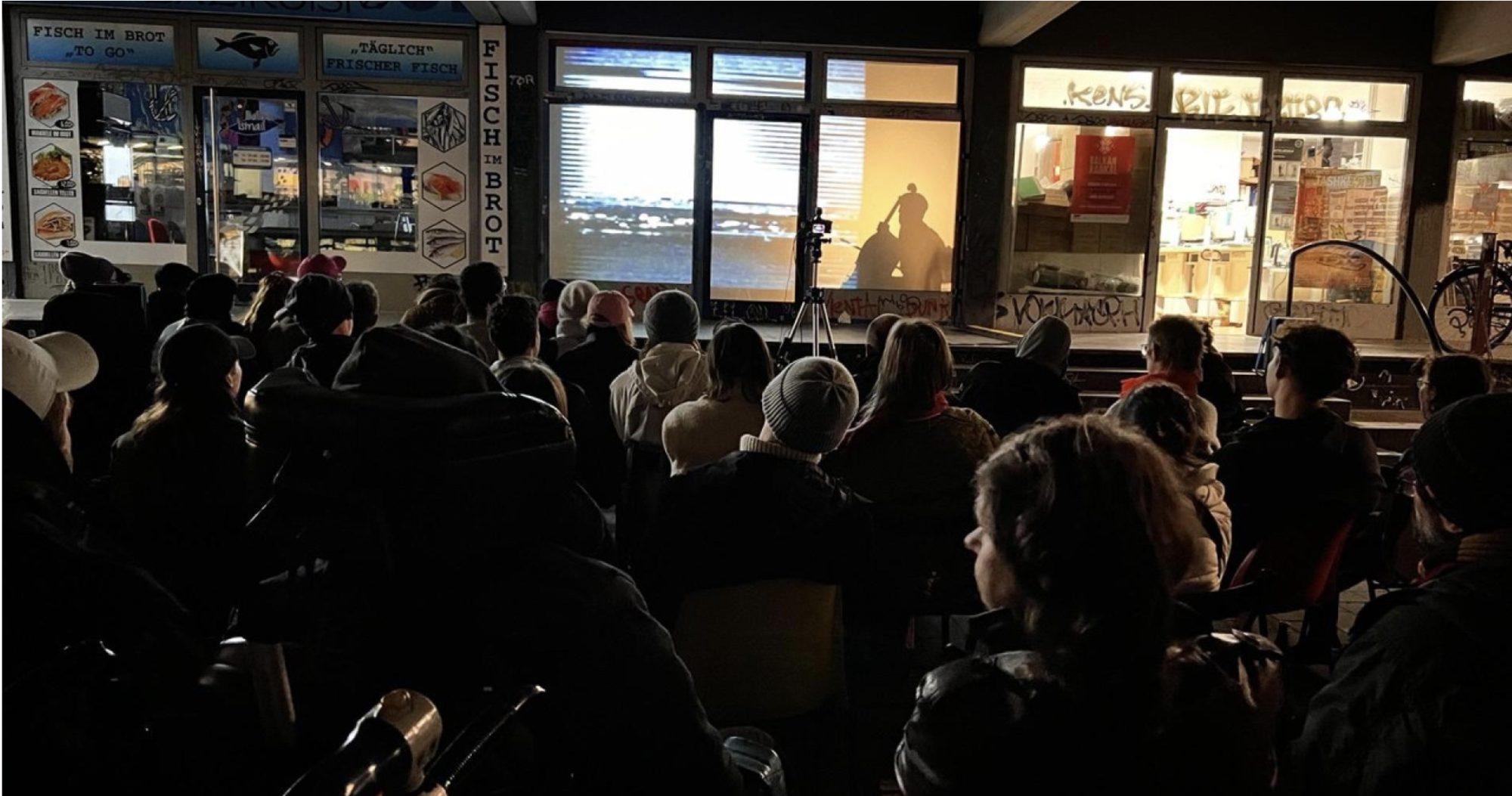
With the 79th Issue, the series Sentimental Punk’s 11th October anniversary celebrated ten years of feminist experimental film with improvised live music in the Hochhausschlucht. What began as an archive project has now become a fixed date in the open-air calendar and regularly transforms the grey alley between Kottbusser Tor and Zentrum Kreuzberg into a communal meeting place. Franziska Busse reports for field notes of an evening with »art-core«, cello and cable salad.
Saturday evening, in the heart of Kreuzberg. Between the concrete playground, the late purchase and the bar, the temporary stage of the Kotti shop – a place for experimental art formats in Berlin, rises. The audience has gathered, some take a seat, others stop near the bar. Despite – or precisely because of – the urban hustle and bustle, the mood seems gathered, tense, open. The view is on the glass front of the store.
It is the last presentation of the three-part anniversary program of Sentimental Punk, which took place over the summer in the Kotti-Shop. The concert series has been celebrated since July »A 10‐Year Anniversary in 3 Acts« – with historical footage and contemporary live soundscapes that respond to the moving image. The films come from feminist archives. Bodies in motion, blurs, super-8 aesthetics, anger, tenderness and resistance permeate the images.
Sentimental Punk is a non-commercial research platform with a special focus on feminist perspectives, which has been dedicated to the cinematic work of queer and underground contexts since 2015. “After some time, I noticed that almost exclusively male names appeared in the archives and sources I had access to – no surprise,” explains curator and founder Dafne Narvaez Berfein. “From 2015 onwards, I focused on structural and avant-garde filmmakers in a targeted manner.”
What once began as an informal research meeting in the Kotti shop developed into a hybrid format in public space during the pandemic: projections on the shop window front and improvised live soundtracks in the interior make the archive accessible and collectively experienceable. It is curated by Narvaez Berfein herself in close collaboration with an international community of artists and curators, including Lisa Simpson, Julia Brunner, Santiago Doljanin, Eugenia Seriakov, Christina Ertl-Shirley, Amirali Ghasemi, Julia Herfurth.
The cinematic centerpiece of the evening is a collage by Narvaez Berlfein from early works by the New York avant-garde icon MM Serra, whose works have combined radical physicality, feminist subversion and structural experimentation since the 1980s. Mary Magdalene aka MM Serra, who spent over three decades as executive director of the legendary Film-Makers’ Cooperative – the world’s oldest and largest archive for independent film – is one of the defining voices of experimental underground cinema. The selection of the collage for the anniversary event on 11.10.25 was created under the programmatic title »Mary Magdalene, Art-Core« – a term that Serra himself defined in her »9th Annual Experimental Lecture« as »the explicit in the cinematic body , which explores the abjective body in all its chaotic, physical magnificence – in its pleasure and pain« (»Millenn 51″, 2009). »Art-Core« is thus not only title, but also an aesthetic and political manifesto of a cinematic practice that makes vulnerability and lust equally visible. The projection shows close-ups of female bodies – raw, intimate, political – a tribute to desire and resistance to female perspectives.
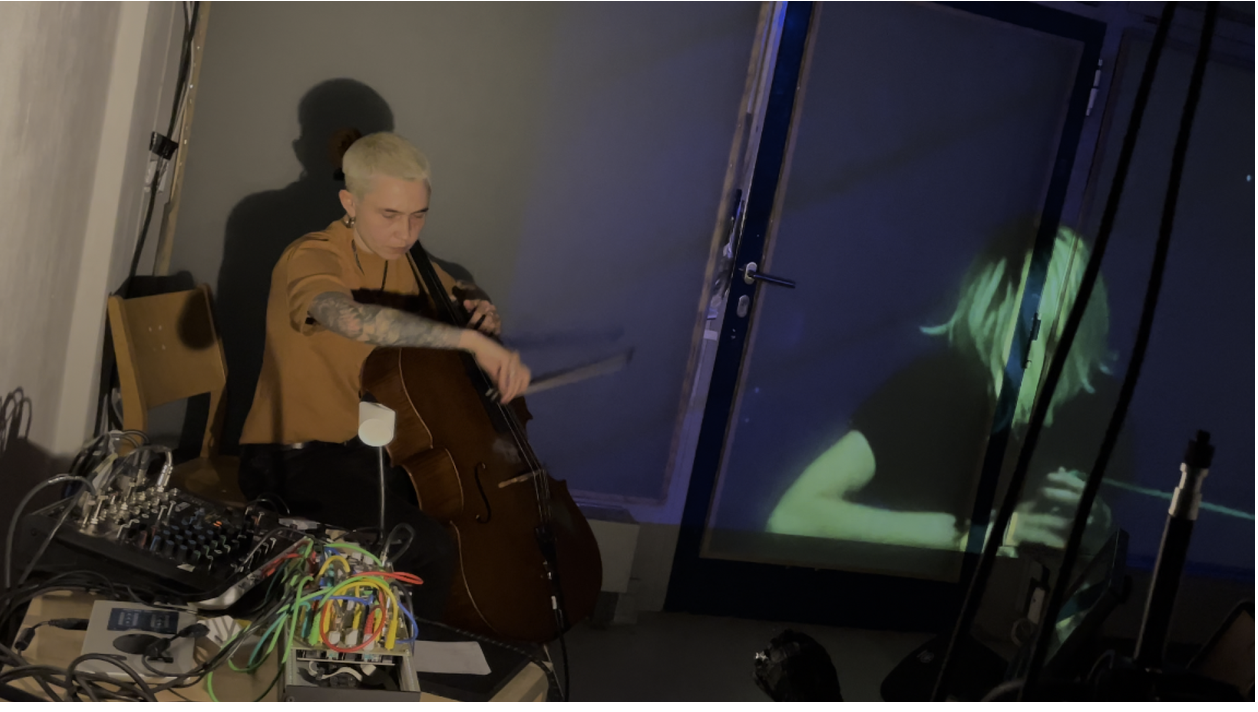
Sentimental Punk #79 – Mary Magdalene, Art-Core – M.M. Serra early films, a lot of fun for the evil one« presents the film collage in two consecutive live soundtrack performances, each conceived as a solo concerto and in direct interaction with the projected archival material. Alina Anufrienko designs the first part with electro-acoustic improvisations on a prepared cello – an instrument that is not only painted, but beaten, plucked and manipulated with various objects. With the help of loops, samples and subtly used effects, a multi-layered soundscape is created that is far from conventional stringed instrument sounds. Anufrienko develops a fragile and at the same time haunting soundscape live, which does not simply accompany the moving bodies and atmospheric nature images, but sensitively comments and reflects rhythmically and emotionally. The play between repetition and variation, silence and disturbance creates an auditory space that allows intimacy and at the same time makes distance – a musical examination of body images, fragmentation and feminist representation.
For the second part of the evening, Kaffe Matthews, a pioneer of electro-acoustic composition that has been opening up new ways of listening and composing for decades, has brought her current modular instrument. The »Ripley« is a specially developed sound system that, on the »12 Gates« of the 15th Alchemical Findings, is the “12 Gates”. Century based and backfeeding, live sampling and filtering disturbances transferred to an open improvisation format. Parallel to the film projection, Matthew’s silhouette features a complex network of cables, devices and modules – a visual echo of the tonal interconnections that asserts itself like a shadow instrument next to the film. Matthews’ approach is both physical and speculative. She works with space, data, audience and objects and develops a music that creates itself at the moment.
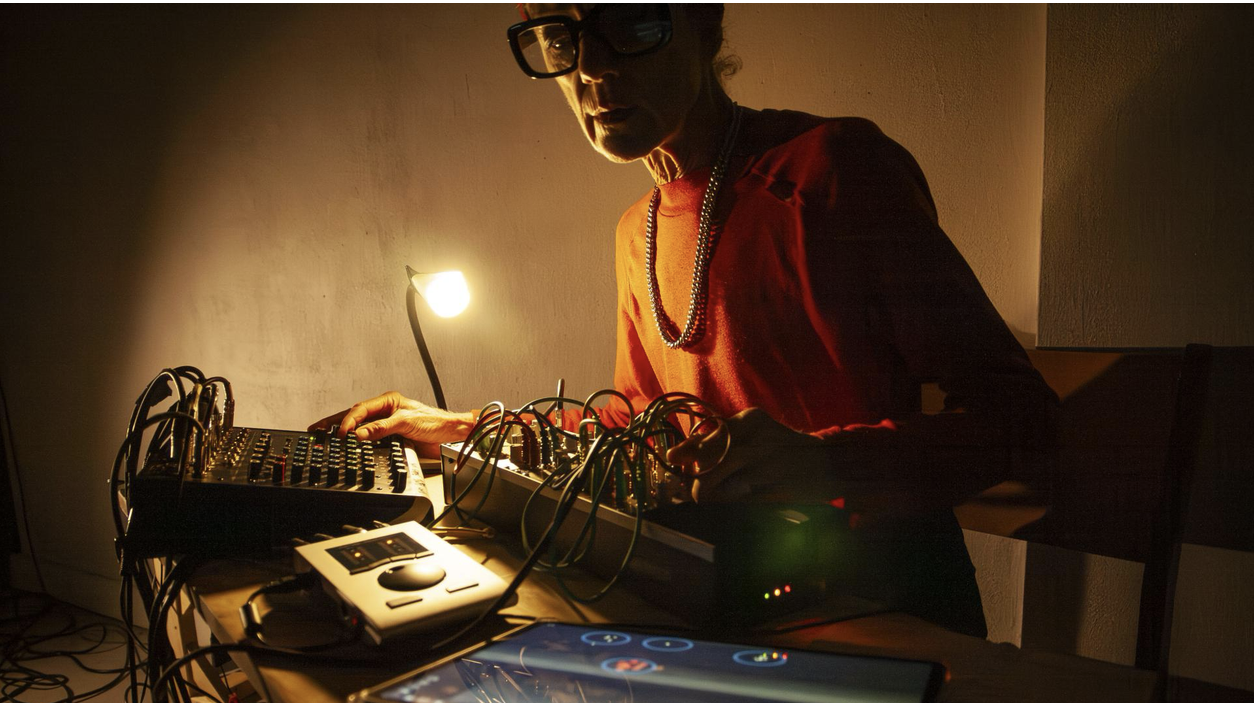
The live soundtrack penetrates the projected footage in a different way than in the first part of the evening: While Alina Anufrienko’s performance seemed almost intimate, atmospheric, Matthews spans a multi-layered, eruptive sound field that fills the room, then breaks, circulates and throws itself back. The combination of synthetic interference, swirling textures and feedback noises opens up an almost ritual listening experience. The music becomes a transformation, an alchemical operation. Matthews’ performance not only functioned as a soundtrack, but also as a sound counterweight to the film. It is a performative dialogue between image and frequency, meaning and disturbance, body and machine.
The performance ends around 10 p.m. Night rest in the courtyard of the New Kreuzberg Center. The chairs are slowly dismantling, but the audience remains. An unplanned follow-up discussion is created, artists and spectators come into the conversation. The Kotti shop, otherwise a passageway, becomes the place of encounter.
ABOUT THE AUTHOR:
Franziska Busse participated in the writing workshop of field notes notes, KlangZeitOrt and positions in 2024 and is a member of the young editorial team of the month of contemporary music this year. Busse, born in Berlin, studied music, sound and performance at the Free University of Berlin. As a member of the youth choir of the Staatsoper Unter den Linden, the mezzo-soprano participated in scenic projects during her bachelor’s degree in musicology and art history (HU Berlin) and focused on new musical theatre and dramaturgy.